Dollarisation Risk for India: Global Agencies Warn on USD-Backed Stablecoins
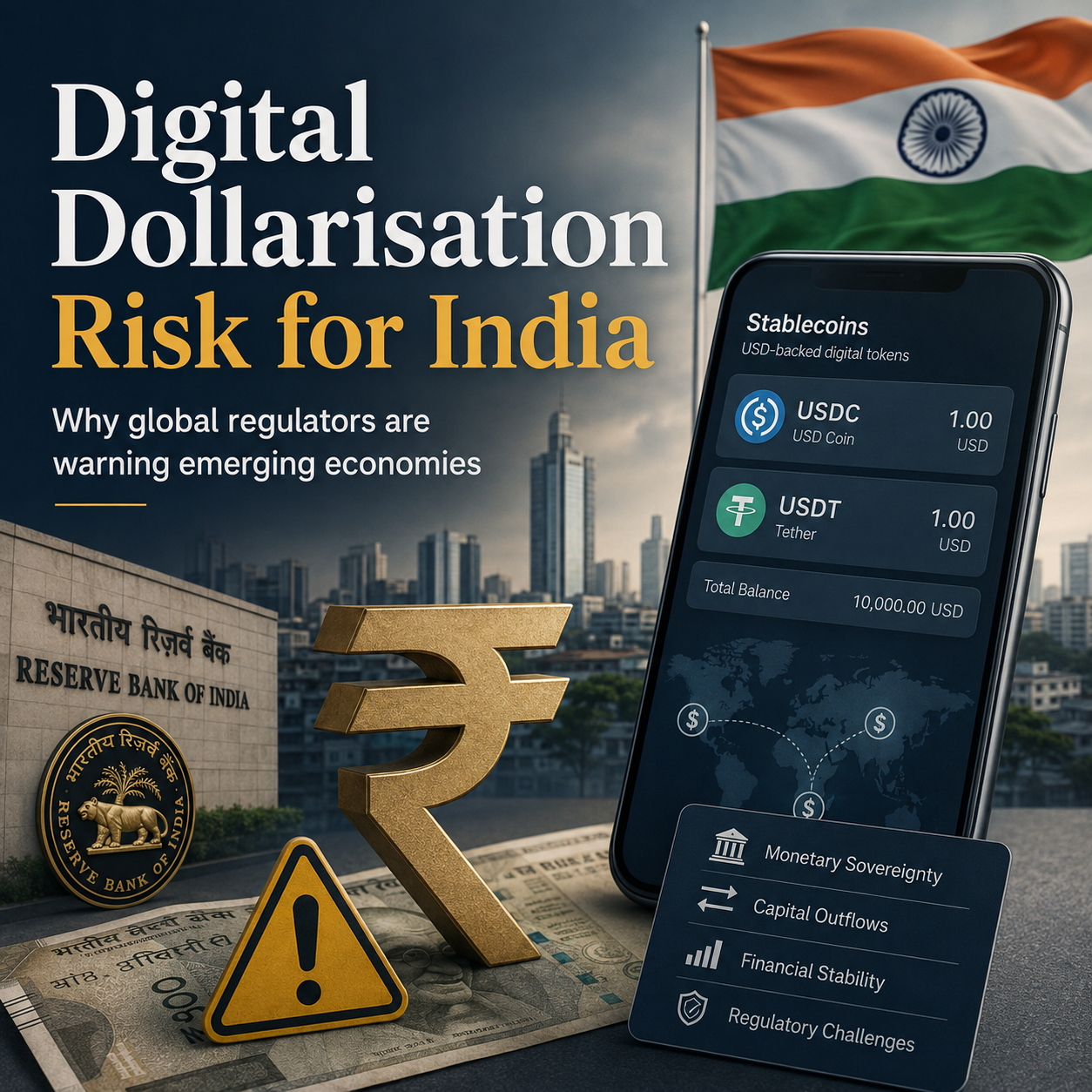
USD-backed stablecoins, digital dollarisation and monetary sovereignty are rapidly emerging as major issues in the global debate on crypto regulation and the future of money.
For India and other emerging-market economies, the most important stablecoin risk may not be crypto volatility.
It may be currency substitution — the gradual movement from domestic currencies toward privately issued digital dollars.
Major international institutions including the Bank for International Settlements (BIS), International Monetary Fund (IMF), Financial Action Task Force (FATF) and OECD are increasingly examining different dimensions of this challenge.
BIS Warning: Stablecoin Dollarisation and Emerging Markets The Bank for International Settlements (BIS) has placed stablecoin dollarisation directly on the global policy agenda. BIS research published in 2026 examines how easy access to US-dollar liquidity through stablecoins could change traditional patterns of dollarisation.
With approximately 98% of stablecoin value denominated in US dollars, BIS researchers warn that widespread adoption could reinforce existing global currency hierarchies and create particularly serious monetary-sovereignty risks for emerging-market and developing economies. The critical difference is accessibility.
Traditional dollarisation usually requires access to foreign currency, foreign bank accounts or conventional financial intermediaries. Digital dollarisation can happen through a smartphone and a crypto wallet.
Local currency can potentially move through: Local Currency → Crypto Platform/P2P Market → USD Stablecoin → Digital Wallet → Global Transfer BIS research published on 21 July 2026 found similarities between conventional dollarisation and stablecoin dollarisation, including sensitivity to exchange-rate pressures and financial stress. This raises an important question for India: Could USD-backed stablecoins eventually become a parallel digital store of value during periods of currency or financial stress? IMF Warning: Currency Substitution and Monetary Sovereignty The International Monetary Fund (IMF) has highlighted perhaps the most important macroeconomic danger: currency substitution.
Foreign-currency stablecoins can make holding and transferring dollar-denominated value substantially easier. For emerging markets, widespread adoption could affect: monetary-policy transmission, domestic currency demand, capital-flow volatility, capital-flow-management measures, financial stability, and monetary sovereignty. The IMF warned in May 2026 that foreign-currency stablecoins can displace domestic currency in transactions and savings, particularly where inflation is high, exchange rates are volatile or institutional credibility is weak. It also highlighted the possibility that stablecoins could increase de facto capital mobility and make capital-flow-management measures harder to enforce.
This makes digital dollarisation fundamentally different from an ordinary crypto-investment debate. It is potentially a question about the future effectiveness of national monetary policy.
FATF Warning: Stablecoins, P2P Transfers and Unhosted Wallets The Financial Action Task Force (FATF) approaches the stablecoin issue primarily through the lens of global financial integrity. In March 2026, FATF published a dedicated report on Stablecoins and Unhosted Wallets — Peer-to-Peer Transactions.
FATF highlighted illicit-finance risks associated particularly with stablecoins used through P2P transactions and unhosted wallets, and called for stronger implementation of international controls protecting the integrity of the financial system.
This becomes particularly important because blockchain-based financial activity can cross national borders differently from conventional banking transactions.
For emerging economies, the issue therefore extends beyond dollarisation. It also involves: AML/CFT compliance, cross-border crypto flows, offshore platforms, unhosted wallets, P2P crypto transactions and international financial intelligence.
OECD: Stablecoins and Global Crypto Tax Transparency The OECD addresses another part of the same global challenge through the Crypto-Asset Reporting Framework (CARF).
As crypto-assets and stablecoins increasingly facilitate cross-border holdings and transactions, traditional tax-information systems designed around financial institutions face new challenges.
CARF is part of the international effort to extend tax transparency and automatic exchange of information into the crypto-asset ecosystem. This creates another important dimension of the stablecoin debate: digital dollarisation is not only a monetary-policy issue — it can also become a cross-border financial-transparency issue.
Why Digital Dollarisation Matters for India India should closely monitor this global debate.
The Indian rupee operates at the centre of one of the world's largest emerging-market economies. But USD-backed stablecoins can potentially provide users with digital exposure to the world's dominant reserve currency without requiring the same infrastructure traditionally associated with holding foreign currency.
If stablecoins eventually become widely used for: digital savings, cross-border payments, crypto trading, P2P transfers, commercial settlement, DeFi, or international remittances, the distinction between a “crypto asset” and a parallel digital currency infrastructure could become increasingly important.
This does not mean stablecoins have already dollarised India. It means the architecture capable of enabling digital currency substitution now exists.
And global regulators are increasingly studying what happens if adoption reaches systemic scale. Stablecoin Regulation Is Becoming a Monetary-Sovereignty Debate The global conversation around stablecoin regulation in 2026 is therefore much larger than USDT, USDC or crypto trading. It involves: USD-backed stablecoins stablecoin dollarisation digital dollarisation currency substitution monetary sovereignty capital flows emerging-market financial stability cross-border crypto payments unhosted wallets P2P crypto transactions AML/CFT crypto tax transparency stablecoin regulation and ultimately, the future of money. The warnings emerging from BIS, IMF, FATF and OECD address different parts of the same structural transformation. BIS: stablecoin dollarisation and monetary control. IMF: currency substitution, capital mobility and monetary sovereignty. FATF: illicit-finance risks involving stablecoins, P2P activity and unhosted wallets.
OECD: international crypto-asset reporting and tax transparency. The policy question for India and other emerging economies is becoming increasingly significant: What happens to monetary sovereignty when access to digital US dollars becomes as easy as downloading a wallet? The biggest stablecoin risk for emerging economies may therefore not arise from a sudden crypto-market crash.
It could arise gradually — when the domestic currency begins competing with a borderless, privately issued digital version of the world's dominant reserve currency. That is the digital dollarisation risk policymakers should be examining now.