Distributed Ledger Technology
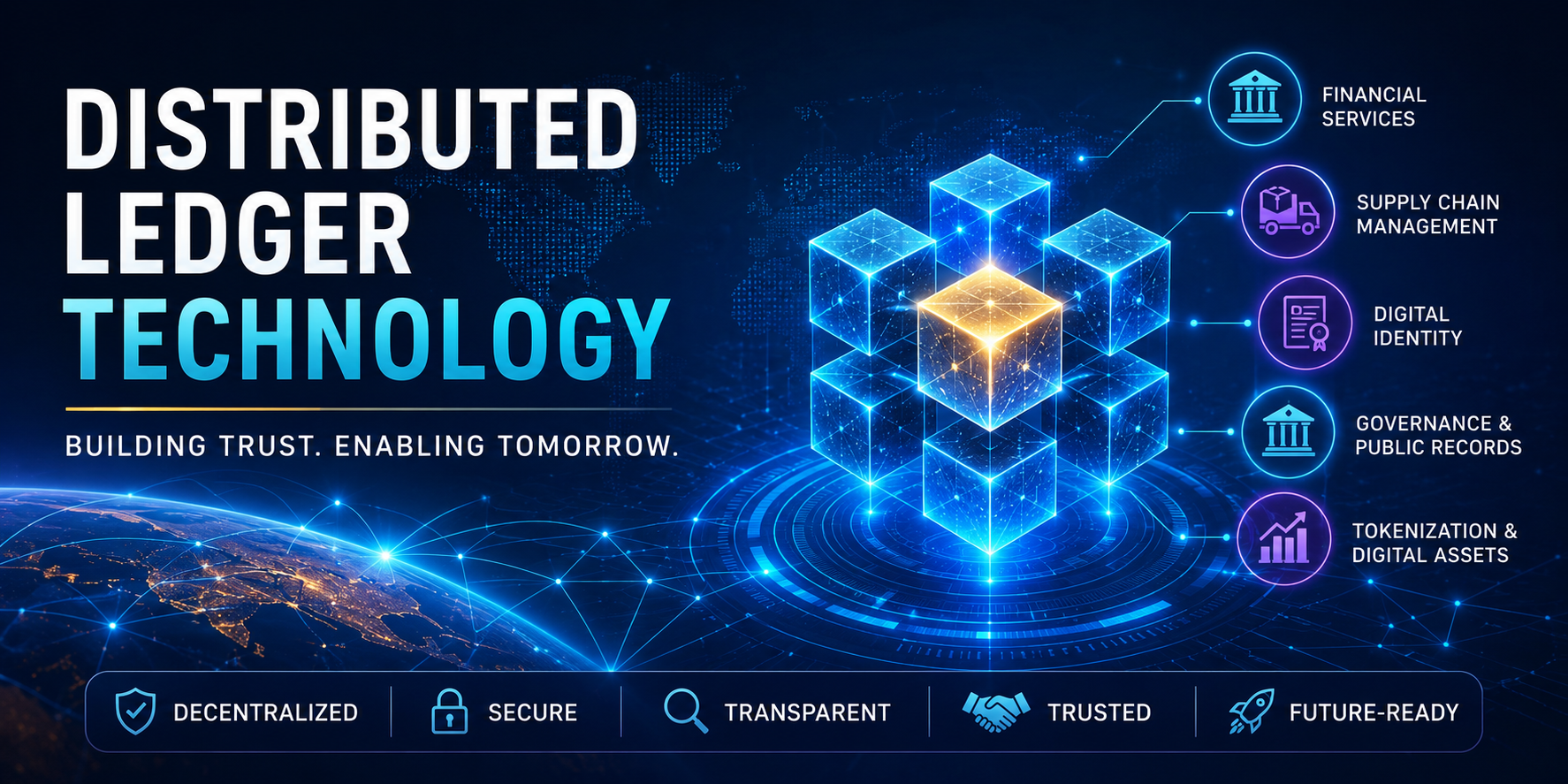
The Infrastructure Layer for Verifiable Digital Trust
How DLT can transform payments, financial markets, supply chains, public records and the digital economy
Distributed Ledger Technology, or DLT, is often discussed as though it were simply another name for blockchain. It is broader than that. At its core, DLT is a method of maintaining a shared digital record across multiple participants so that authorised parties can work from a common, synchronised and independently verifiable version of data. Traditional databases usually depend on one central administrator. DLT changes that architecture. Instead of every institution maintaining its own record and repeatedly reconciling it with others, participants can share a ledger whose updates follow predefined rules. That apparently simple change can alter how organisations establish trust, ownership, provenance and settlement finality. DLT is not merely a technology for moving digital assets. It is an architecture for allowing multiple parties to agree on the state of information without requiring one party to control the entire record.
DLT and Blockchain Are Related — But Not Identical A distributed ledger is a database whose records are replicated or shared among several participating nodes. A blockchain is one particular form of distributed ledger in which transactions are generally grouped into blocks and linked cryptographically. So: Blockchain ⊂ Distributed Ledger Technology DLT systems can use different approaches to data structures, consensus, permissions and governance. The important innovation is not necessarily the “block.” It is the ability to maintain shared state among multiple independent participants.
How DLT Works A typical DLT transaction can be understood through a simple sequence: Transaction initiated ↓ Identity / permission checked ↓ Transaction broadcast to authorised participants ↓ Validation rules applied ↓ Consensus reached ↓ Ledger state updated ↓ Cryptographic record retained ↓ Authorised participants see the same updated state Unlike a conventional database, participating organisations do not necessarily have to rely on another institution's private internal ledger as the sole source of truth. The network itself becomes part of the verification architecture.
The Five Building Blocks of DLT A DLT network normally combines: • Distributed records: multiple authorised nodes maintain or validate ledger information. • Cryptography: digital signatures, hashing and cryptographic proofs help protect integrity and authenticate transactions. • Consensus: predefined mechanisms determine how participants agree that a transaction or state change is valid. • Smart contracts: programmable rules can automatically execute predefined actions when conditions are satisfied. • Governance: technical rules determine who can participate, validate, upgrade software, resolve disputes and access information. The technology therefore combines data architecture, cryptography, network governance and programmable execution.
Where DLT Can Add the Greatest Value The strongest use case for DLT is generally not a process controlled entirely by one organisation. A conventional database may be simpler and more efficient in that situation. DLT becomes more relevant when several independent institutions must repeatedly exchange, verify and reconcile the same information. The chart below is an illustrative architectural assessment, not measured market data. The message is important: DLT should solve a coordination problem, not merely replace a database because blockchain is fashionable.
Public, Private and Consortium DLT Not every distributed ledger is open to everyone. Public Permissionless DLT Anyone may generally participate according to the protocol's rules. Bitcoin and public blockchain architectures popularised this model. Security is created through distributed consensus, cryptographic incentives and protocol rules rather than through membership in a closed institutional network. Private Permissioned DLT Participation is restricted. An institution or defined governance body determines which nodes can join, read information, submit transactions or validate records. This architecture is often more relevant where confidentiality, regulatory accountability and known counterparties are required. Consortium DLT A group of organisations collectively operates the ledger. Instead of one institution controlling the database, governance is distributed among several recognised members. This model can be particularly relevant to banking, trade finance, supply chains, capital markets and inter-institutional infrastructure. The following chart is again a conceptual architectural comparison, not an empirical ranking.
Why DLT Matters to Financial Markets Financial systems contain enormous amounts of reconciliation. Banks maintain records. Brokers maintain records. Custodians maintain records. Depositories maintain records. Clearing houses maintain records. Payment institutions maintain records. Regulators receive another version of those records. Each institution may be correct internally while still requiring continuous reconciliation with everyone else. DLT introduces another possibility: multiple institutions operating from a synchronised transaction state. That can potentially change the infrastructure supporting: payments → clearing → settlement → custody → collateral → securities issuance → corporate actions → regulatory reporting The significance is therefore not simply “crypto.” The deeper question is whether parts of financial-market infrastructure can move from message-based reconciliation toward shared-state settlement.
Tokenisation: DLT's Connection to Real-World Assets DLT also provides infrastructure for tokenisation. A token can digitally represent a claim, entitlement or record associated with an underlying asset. Possible examples include: government securities, corporate bonds, fund units, invoices, trade-finance instruments, commodities, real estate interests, carbon instruments, intellectual-property rights, or other legally recognised assets. But tokenisation does not magically convert an electronic record into legally enforceable ownership. The crucial architecture is: Token • legally recognised claim • verified issuer • ownership registry • settlement mechanism • custody/control rules • enforceable redemption rights Without that connection, a token may simply be a digital record whose relationship to the underlying asset is unclear. This is why the future of tokenisation depends as much on law and institutional design as on software.
Smart Contracts: From Recording Transactions to Executing Rules Traditional ledgers primarily record what has happened. DLT systems can go further. Smart contracts allow predefined instructions to execute when specified conditions are satisfied. Consider a simplified bond transaction. Traditionally: Buyer sends payment. Seller transfers securities. Intermediaries reconcile records. Custodians update positions. Settlement institutions confirm completion. With programmable infrastructure, payment and asset transfer could potentially become linked: If payment condition = satisfied → execute asset transfer. This concept is particularly relevant to delivery-versus-payment, collateral management and automated financial operations. However, smart contracts introduce another important principle: Code can automate an agreement, but code does not eliminate legal responsibility. Incorrect data, software defects, compromised keys, governance failures and badly designed contractual logic can still create serious problems.
DLT and Supply-Chain Transparency The same architecture has applications outside finance. A product moving through a supply chain may generate records from: manufacturer, logistics company, customs, warehouse, distributor, retailer, auditor, and final buyer. If these organisations use separate databases, tracing the history of an item may require records to be collected and reconciled retrospectively. A shared ledger can potentially create a chronological provenance trail: Source → Production → Inspection → Shipment → Customs → Warehouse → Retail This can be particularly relevant for pharmaceuticals, food, luxury goods, precious metals, industrial components and other products where provenance matters. But DLT provides tamper-evidence, not automatic truth. If false information is entered at the beginning, blockchain cannot magically determine that the physical information was false. This is the classic: “Garbage in, immutable garbage out” problem. Therefore, trusted sensors, inspections, digital identity and accountable data-entry processes remain essential.
DLT and Government Records DLT can also be evaluated for public-sector record systems where several authorities need to verify the same information. Potential areas include: land-record verification, certificates, licences, public procurement, grant tracking, document authentication, supply-chain records, educational credentials, and selected audit trails. The key design question is not: “Can this be put on blockchain?” Almost anything can. The better question is: “Does this process have a multi-party trust or reconciliation problem that DLT materially improves?” If the answer is no, a conventional secure database may remain the better technology.
DLT Is Not Automatically Immutable The word immutable is frequently overused. DLT can make historical records extremely difficult to alter unnoticed because transactions may be cryptographically linked and replicated across participants. But systems still have governance. Networks can be upgraded. Smart contracts can contain administrative controls. Data can be corrected through new transactions. Keys can be compromised. Validators can make mistakes. Governance bodies can intervene. The more precise description is therefore often: tamper-evident and cryptographically verifiable rather than absolutely immutable. That distinction is important for serious institutional deployment.
DLT Does Not Remove Trust — It Redistributes It Perhaps the greatest misunderstanding surrounding blockchain is the phrase “trustless technology.” No meaningful economic system is completely trustless. DLT shifts where trust is placed. Instead of trusting one database administrator, participants may rely on: protocol rules, cryptography, validator governance, digital identities, oracle providers, software developers, custodians, key-management systems, and legal institutions. The trust model therefore changes from: “Trust this institution's database.” to: “Trust that the network, governance, cryptography and legal structure collectively produce a reliable state.” That is a profound architectural shift.
The Real DLT Stack A serious institutional DLT system can be understood as several interconnected layers: Application Layer Payments, securities, supply chain, credentials, records ↓ Smart-Contract Layer Rules, automation and programmable rights ↓ Ledger Layer Transactions and shared state ↓ Consensus Layer Agreement between participating nodes ↓ Identity & Permission Layer Who can read, write, validate or administer ↓ Cryptographic Layer Keys, signatures and hashes ↓ Governance & Legal Layer Ownership, liability, compliance, dispute resolution and authority The final layer is often overlooked. Yet for banks, governments and regulated institutions, legal enforceability may be as important as consensus software.
The Most Important DLT Design Question Before implementing distributed-ledger infrastructure, an organisation should ask: Are there multiple independent parties? Do they maintain overlapping records? Do they repeatedly reconcile those records? Is provenance important? Is there a need for shared transaction finality? Can governance be clearly established? Can privacy be protected? Can legal ownership be connected to the digital record? If most answers are yes, DLT may be worth serious consideration. If one organisation controls everything and no external reconciliation problem exists, a conventional database may remain faster, cheaper and simpler.
The Future: From Digital Records to Digital Trust Infrastructure The first generation of the internet transformed information. The second transformed commerce and communication. DLT is exploring a different problem: how independent organisations can share authoritative digital state. Its long-term importance may therefore extend far beyond cryptocurrency. The more consequential applications may eventually involve: tokenised finance, programmable settlement, digital identity, verifiable credentials, transparent supply chains, shared regulatory infrastructure and machine-to-machine economic transactions. The real promise of Distributed Ledger Technology is not that every database will become a blockchain. It is that certain economic processes may no longer require every participant to maintain a separate version of reality and spend enormous resources proving that those versions agree. That is the deeper transformation: From duplicated records to shared truth. From reconciliation to verification. From digital information to programmable trust. Distributed Ledger Technology may ultimately become less visible as a technology precisely when it becomes more important as infrastructure. Where DLT can add architectural value Illustrative design-suitability score. Higher values indicate situations where shared ledgers may offer greater architectural benefits; these are conceptual scores, not market statistics. useCase suitability Multi-party settlement 5 Shared provenance records 5 Cross-organisation reconciliation 5 Tokenised asset infrastructure 4 Regulatory audit trails 4 Single-owner internal database 1 DLT network models Illustrative comparison of openness across common distributed-ledger architectures. Scores represent conceptual openness on a five-point scale. network participation validation Public permissionless 5 5 Public permissioned 5 2 Consortium 2 2 Private permissioned 1 1