Blockchain + AI + Cloud: Building the Next Digital Infrastructure
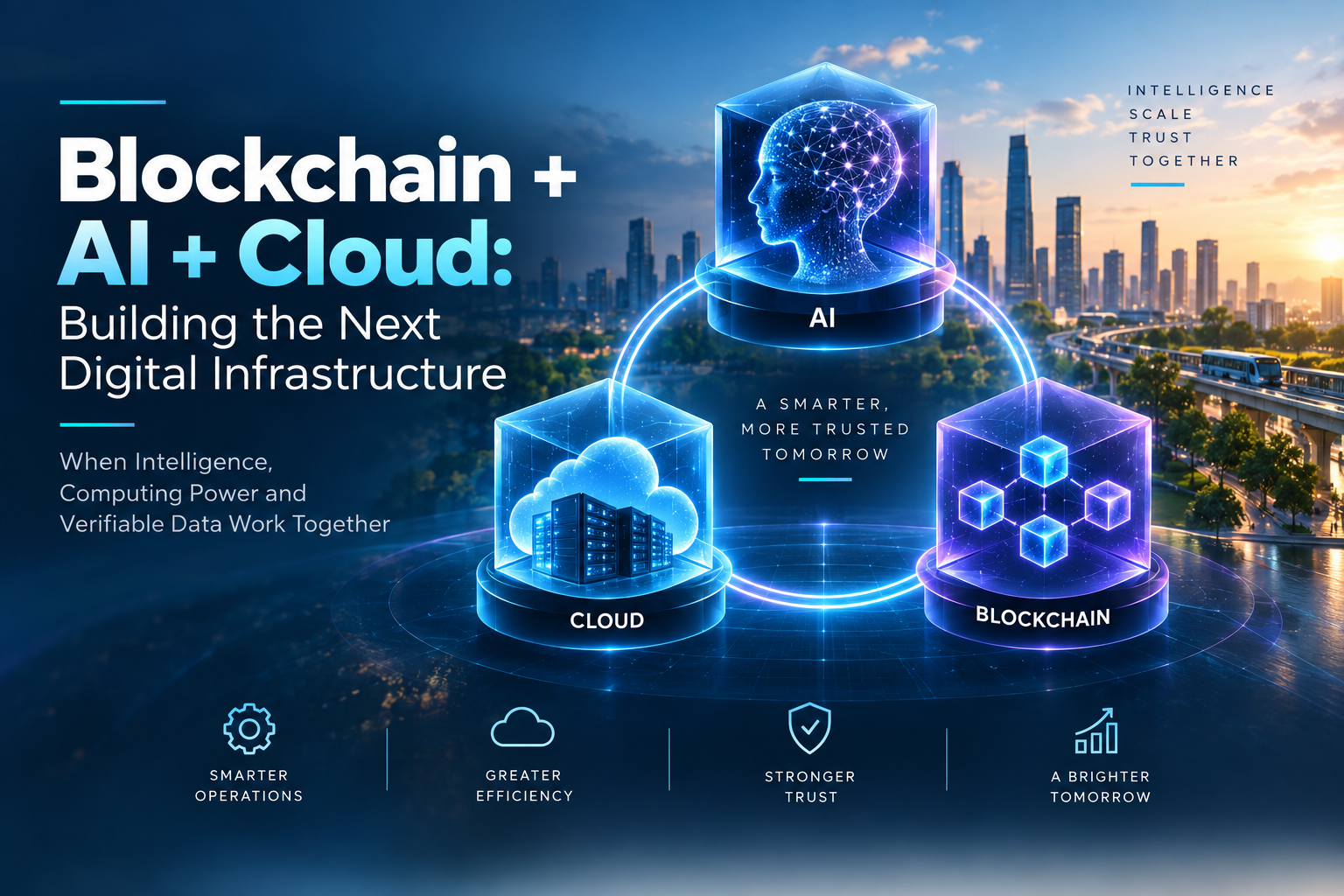
When Intelligence, Computing Power and Verifiable Data Work Together
Modern digital systems are becoming increasingly dependent on three capabilities.
They need to process enormous amounts of data, understand that data intelligently, and maintain confidence in the information being exchanged.
This is where cloud computing, artificial intelligence and blockchain begin to complement one another.
Cloud provides scalable computing and storage. AI analyses data and supports decisions. Blockchain can provide a shared, verifiable record of selected events, identities and data exchanges.
Research examining the convergence of these technologies describes blockchain as supporting secure data exchange and identity verification, AI as enabling predictive and adaptive decision-making, and cloud computing as providing scalable infrastructure.
Three Technologies, Three Different Jobs
Imagine a smart manufacturing environment.
Thousands of machines continuously generate information.
Cloud infrastructure stores and processes large volumes of operational data. AI models analyse that information to identify unusual patterns or predict equipment failures.
But another question remains:
How can different systems know which data, model update or operational event can be trusted?
Blockchain can provide a verifiable record for selected events.
A simplified architecture could look like:
Machine Data → Cloud Processing → AI Analysis → Decision/Event → Verification → Blockchain Record
The blockchain does not need to store all the raw machine data.
Large files, sensor streams and AI datasets can remain in conventional cloud or edge infrastructure. Blockchain can instead record hashes, permissions, approvals, important events or evidence that a particular action occurred.
Why This Combination Matters
Consider predictive maintenance. An AI system identifies that a machine may require maintenance. The cloud platform processes the machine's historical information. The maintenance team receives an alert. The completed maintenance event can then be recorded in a shared, tamper-evident system.
This creates a chain:
Machine Event → AI Detection → Maintenance Action → Verification → Recorded History
Over time, this can provide a more reliable operational history.
The Challenge Is Integration
Combining three technologies does not automatically produce a better system.
AI models can produce incorrect predictions.
Cloud systems introduce security and availability considerations.
Blockchain can introduce latency, scalability and governance challenges.
Research in this area specifically identifies interoperability, latency, security trade-offs and resource allocation as important challenges.
The architecture therefore needs to decide what belongs on the cloud, what should happen at the edge, what AI should process and what information genuinely needs blockchain verification.
A Practical Architecture A sensible model is:
Cloud → Large-scale storage and computing
AI → Analysis and prediction
Edge → Fast local decisions
Blockchain → Verification, identity and audit
This division is important because blockchain should not become the place where every operation happens.
The Next Digital Infrastructure
The real opportunity is not simply “AI + blockchain + cloud.”
It is the ability to create systems where:
Data can be processed → Decisions can be made → Actions can be verified → Important events can be independently audited.
That combination could become increasingly relevant in manufacturing, logistics, healthcare, smart infrastructure and other complex digital environments.
The technology is still evolving, but the direction is clear: future digital infrastructure will need not only intelligence and scale, but also verifiable trust.