Blockchain in 5G and 6G: Building Trust Between Connected Systems
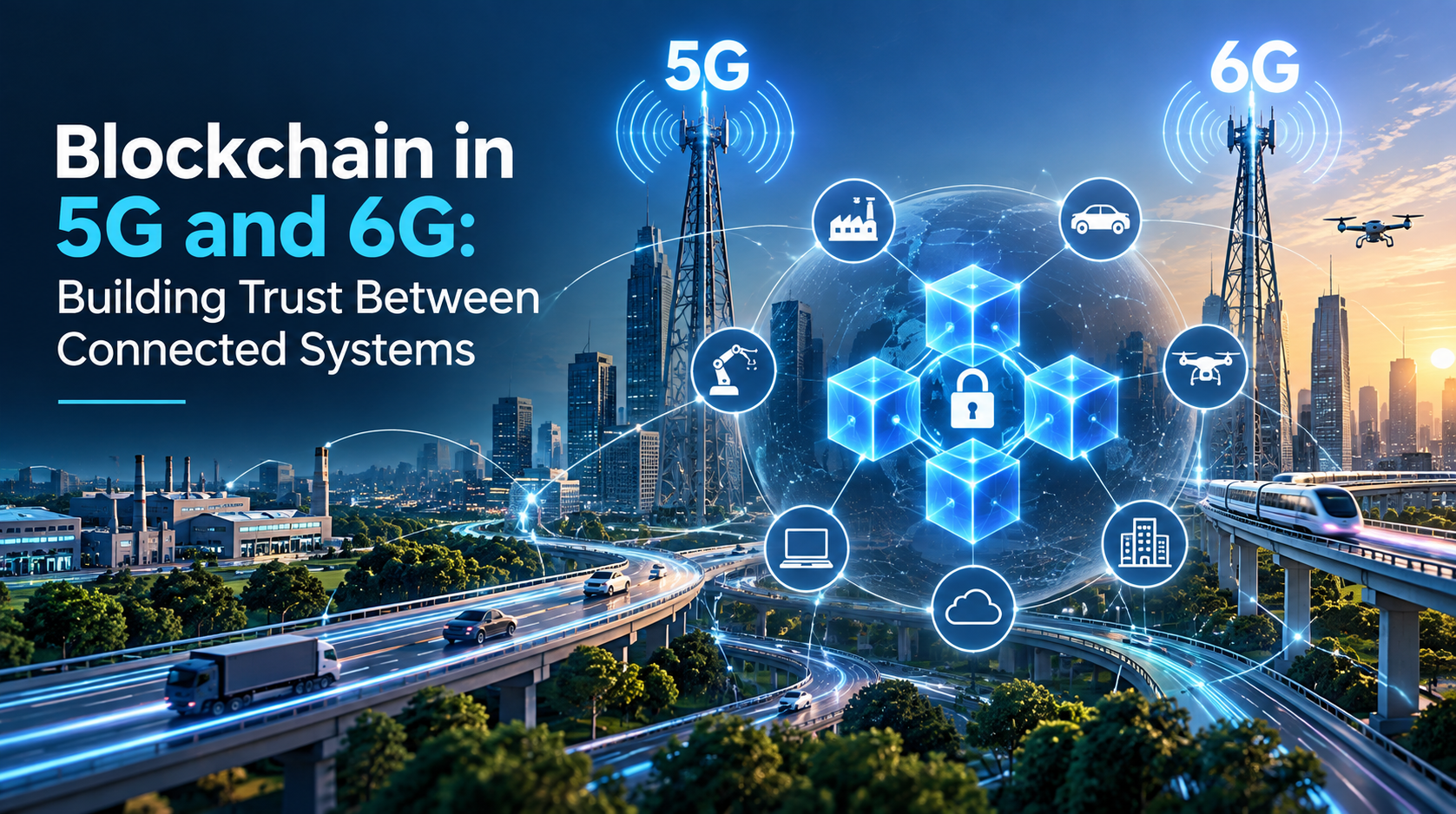
As Networks Become More Distributed, the Challenge Is No Longer Just Connectivity
5G and future 6G networks are designed to connect enormous numbers of devices, services and organisations.
Smart factories, autonomous systems, connected vehicles, IoT devices and edge computing environments may operate across infrastructure controlled by different organisations.
The challenge is therefore not simply:
“Can these devices connect?”
It is:
“Can these systems trust one another?”
Research into blockchain and communication networks identifies blockchain as a potential layer for trust, automation and security in increasingly open and multi-tenant 5G environments.
Consider Network Slicing
5G allows operators to create virtual network slices designed for different requirements.
A smart factory may need one type of service.
An autonomous vehicle application may require another.
A critical industrial application may have different latency and reliability requirements.
Blockchain can help maintain a verifiable record of how these network slices are created, modified and managed.
A simplified process could be:
Service Request → Policy Verification → Slice Creation → Performance Monitoring → Record Updated
For example, an agreement can define parameters such as bandwidth, latency, geographical coverage and duration. Performance information can then be periodically recorded to establish an auditable history.
Trust Across Multiple Operators
The situation becomes more complicated when different operators share infrastructure.
One operator may provide connectivity.
Another may provide an edge server.
A third organisation may operate the application.
Blockchain can provide a common record for selected agreements, identities and service events.
This reduces the need for every organisation to maintain a completely separate version of the same history.
Privacy Still Matters
A transparent network does not mean every piece of information should become publicly visible.
Communication metadata can itself reveal sensitive information.
Research therefore points toward permissioned systems, selective disclosure and recording hashes or commitments rather than raw information.
Blockchain Should Not Run Everything
A 5G network has extremely demanding real-time requirements.
Putting every network operation directly on blockchain would introduce unnecessary overhead.
A better architecture is:
Real-Time Network Control → Conventional/Edge Systems
Identity, Agreements, Verification and Audit → Blockchain Layer
This separation is particularly important for future 6G environments.
What Comes Next?
As networks become more distributed, trust between operators, devices and services will become increasingly important.
Blockchain may not become the core of the network.
It may instead become something more subtle:
a shared trust and accountability layer operating behind the network.