Blockchain in Supply Chains: From Paper Trails to Digital Trust
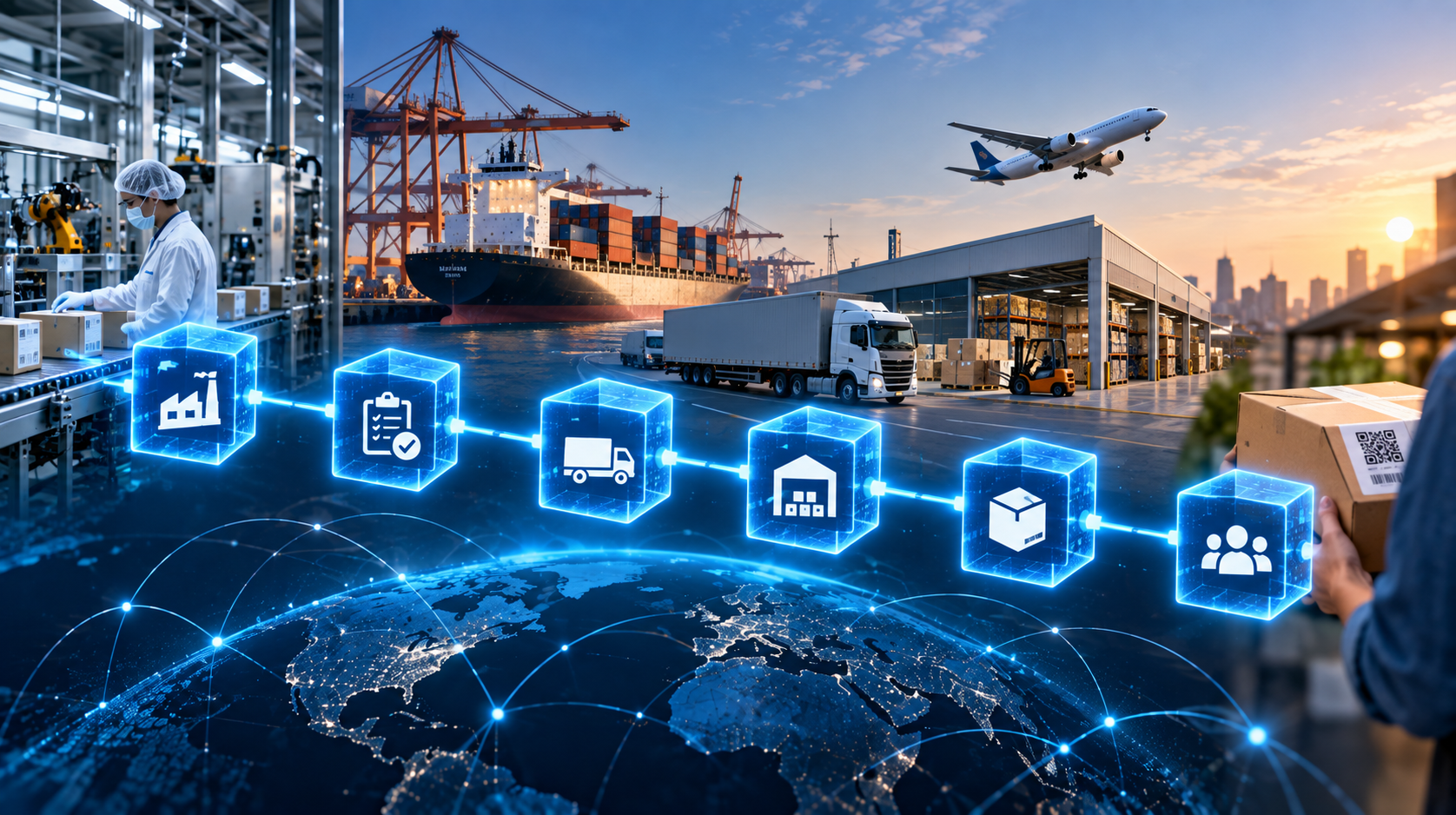
Can a Product’s Journey Become Easier to Verify from Factory to Customer?
A product rarely travels directly from manufacturer to customer.
It may pass through factories, inspection centres, transport providers, warehouses, distributors, customs authorities and retailers.
Every step generates information.
The problem is that these organisations often maintain separate records.
When something goes wrong, investigators must reconstruct the journey from multiple databases, documents and emails.
Blockchain offers another approach.
One Shared History
A blockchain-based supply-chain system could record important events across the journey:
Production → Inspection → Shipment → Warehouse → Distribution → Delivery
Each authorized participant records its part of the process.
Instead of asking every organization for its version of the history, authorized parties can refer to a shared record.
Research on blockchain in supply-chain and logistics systems identifies transparency, traceability, product-origin verification, secure tracking and operational efficiency as important potential benefits.
Consider a Pharmaceutical Shipment
A medicine leaves the manufacturer.
Its batch information is recorded.
The product passes quality inspection.
The shipment is handed to a logistics provider.
The warehouse confirms receipt.
The distributor records the next transfer.
At each stage, the system can record:
- Organization
- Product/batch identifier
- Timestamp
- Location
- Custody transfer
- Inspection status
- Document reference
If a problem is reported later, the history can be examined.
Blockchain Does Not Verify the Physical Product
There is an important limitation.
Suppose someone enters false information at the manufacturing stage.
Blockchain can preserve that information.
It cannot physically inspect the product.
This is why blockchain supply chains may need to work with:
Blockchain + IoT Sensors + Digital Identity + Inspections + Secure Data Entry
A sensor can capture temperature.
An inspection agency can verify quality.
Digital identity can establish who submitted the record.
Blockchain can preserve the resulting event history.
From Paper Trail to Digital Trail
Traditional supply chains depend heavily on documents.
Blockchain does not necessarily eliminate those documents.
Instead, it can create a verifiable digital trail around them.
This can help organizations answer a simple but important question:
“What happened to this product, and who recorded each step?”
Why This Matters for India
India's supply chains span manufacturing, agriculture, pharmaceuticals, logistics, retail and international trade.
A trusted digital record could be particularly valuable where multiple independent organizations need to coordinate.
The objective is not to put the entire supply chain on blockchain.
It is to make the critical events in the supply chain easier to verify, trace and audit.