From Wallet Trace to Courtroom
Digital South Trust Trains 5,350 Law-Enforcement Officers Across India in Crypto Crime Investigation
As cryptocurrency increasingly appears in investment fraud, cybercrime, digital-arrest scams, P2P fraud, fake trading platforms and cross-border financial investigations, one challenge has become clear: investigators need to understand not only what cryptocurrency is, but how to investigate it as digital evidence.
As of August 2026, Digital South Trust reports that it has trained 5,350 law-enforcement officers across India through its blockchain, cryptocurrency investigation, cybercrime and digital-evidence capacity-building programmes.
The objective has been practical: help investigating officers recognise crypto involvement early, trace transactions, preserve evidence, identify exchange touchpoints and build cases that can move from an initial complaint to investigation and ultimately to court.
Training Built Around Real Cases, Not Just Theory Digital South Trust's approach is centred on scenario-based and investigation-oriented learning.
Instead of limiting sessions to explanations of Bitcoin, blockchain or wallets, officers are taken through patterns commonly encountered during investigations: investment frauds, fake cryptocurrency exchanges, phishing, wallet-drainer links, impersonation scams, pump-and-dump schemes, MLM-linked crypto fraud, social-media-driven scams and movement of suspected proceeds through multiple wallets and exchanges. The methodology follows the lifecycle of an investigation.
Complaint → Identify Crypto → Preserve Evidence → Trace Funds → Identify Exchange/Service → Seek KYC & Supporting Records → Connect On-Chain and Off-Chain Evidence → Asset Action → Court-Ready Documentation This approach is reflected in Digital South Trust's investigation training framework, which treats blockchain tracing as only one part of a larger investigative process.
-
Recognising Crypto at the First Stage of a Complaint The first challenge is knowing when cryptocurrency is involved. Officers are trained to identify critical information such as: Wallet Address | Transaction Hash (TXID) | Cryptocurrency/Token |Blockchain Network | Exchange/App | QR Code | Bank/UPI Source | Suspect Communication Capturing these details early can become important because cryptocurrency can move between wallets, exchanges and blockchain networks quickly. The training therefore emphasises the importance of the first hour and first 24 hours of an investigation.
-
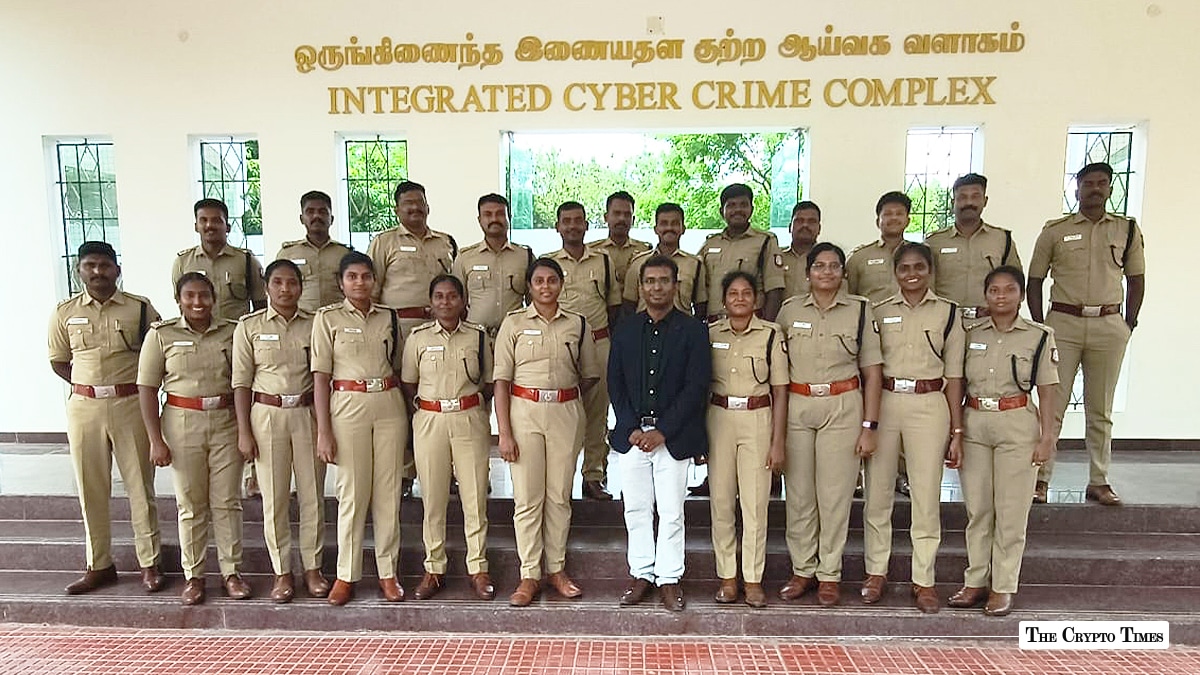
Learning to “Follow the Money” On-Chain Officers receive practical exposure to blockchain explorers and forensic analysis. The objective is to enable investigators to independently understand: Where did the cryptocurrency originate? Where did it move? Which blockchain was used? Did the funds reach another wallet, exchange, bridge or service? What evidence can be independently verified on-chain? During a five-day Tamil Nadu Police Academy programme in May 2026, for example, DSP trainees worked through cryptocurrency crime scenarios and learned to use blockchain explorers and forensic tools to analyse suspicious transaction flows.
-
Hands-On Blockchain Forensics A significant part of the training is practical blockchain investigation. Digital South Trust has provided officers hands-on exposure to Ritam Intelligence, its blockchain forensic platform, alongside public blockchain explorers and other investigative methods. The training reported in May covered networks including Bitcoin, Ethereum, Tron, Solana, Polygon, BNB Chain, Arbitrum, Base, Optimism and Avalanche. Participants learned how transaction flows and wallet relationships can be examined across different networks. (The Crypto Times) But officers are also taught an important investigative principle: A blockchain transaction can show movement of funds. It does not, by itself, prove who controlled a wallet. Attribution must therefore be supported wherever possible through additional evidence such as exchange KYC, IP records, devices, bank accounts, communications and other legally obtained information.
-
Connecting Blockchain Evidence With Real-World Identity This is where the investigation moves off-chain. Training covers how investigators can connect blockchain activity with information obtained through lawful investigative processes, including: Exchange KYC records Registered mobile numbers and email addresses Bank and UPI records IP and device information P2P counterparties Communication records Digital-device evidence The model is designed to help officers distinguish between a transaction that is visible on a blockchain and evidence capable of supporting attribution in an investigation.
-
Exchange Coordination and Rapid Preservation Where funds touch a custodial cryptocurrency exchange or other identifiable service provider, speed can become important. The training framework covers structured preservation and information requests, documentation of wallet addresses and TXIDs, evidence preservation and appropriate coordination with exchanges and relevant authorities. It also emphasises preserving screenshots, chats, URLs, transaction records, blockchain-explorer evidence and other digital material in a manner that protects evidentiary integrity.
-
Digital Evidence and Chain of Custody Crypto investigation cannot end with finding a wallet. Officers also need to demonstrate how evidence was obtained, preserved and analysed. Training therefore includes: digital evidence preservation, hashing of files, documentation of forensic tools, seizure and custody procedures, handling of devices and private-key material, and preparation of investigation records for prosecution. The underlying principle is simple: Trace the transaction. Preserve the evidence. Establish attribution. Document every step.
-
OSINT and Social-Media Investigation Many modern cryptocurrency scams begin outside the blockchain. Victims may first encounter suspects through WhatsApp, Telegram, Instagram, Facebook, X, YouTube, Discord, dating platforms, advertisements or cloned investment websites. Digital South Trust's training methodology therefore incorporates lawful open-source intelligence and preservation of publicly visible or victim-provided digital evidence, including suspect handles, URLs, group information, payment instructions, domains and associated infrastructure.
-
Scenario Drills Instead of Classroom Memorisation The training methodology uses practical scenarios so officers can work through an investigation rather than merely learn terminology. An officer may be presented with a simulated victim complaint containing a bank transfer, USDT transaction, wallet address, Telegram communication and fake investment website. The task is then to determine: What should be collected first? What evidence could disappear? Which blockchain should be checked? Where did the funds move? Is an exchange involved? What additional records are required? What must be preserved for prosecution? This method is intended to develop investigative judgement, rather than dependence on a particular software platform.
Building Law-Enforcement Capability Across India Digital South Trust's law-enforcement capacity-building work has expanded from individual awareness programmes into structured cryptocurrency investigation training.
The May 2026 programme at the Tamil Nadu Police Academy was an intensive five-day course for 26 DSP trainees, covering crypto crime methodologies, blockchain investigation, applicable legal aspects, digital evidence and hands-on forensic analysis.
By August 2026, the Trust's cumulative internal count had reached: 5,350 Law-Enforcement Officers Trained Across India The wider objective is to build investigation capability closer to where cases actually originate — at police stations, cybercrime units, district-level investigation teams and specialised enforcement units. Technology will continue to evolve. New cryptocurrencies, stablecoins, wallets, bridges, exchanges and fraud methods will emerge.
For law enforcement, the fundamental investigative method remains consistent: Recognise Crypto Early → Act Quickly → Follow the Money → Connect Blockchain With Identity → Preserve Evidence → Build a Court-Ready Case That is the capability Digital South Trust's training programmes are seeking to strengthen across India's law-enforcement ecosystem.