Tokenised Bonds and the "Demat 2.0" Pilot: What RBI and SEBI's Tokenisation Push Means for India
On 10 September 2026, at the Global Fintech Fest in Mumbai, RBI Governor Sanjay Malhotra and SEBI Chairman Tuhin Kanta Pandey jointly announced a pilot that most retail investors will not notice for some time. It may still be one of the most significant changes to India's capital markets since dematerialisation in the late 1990s.
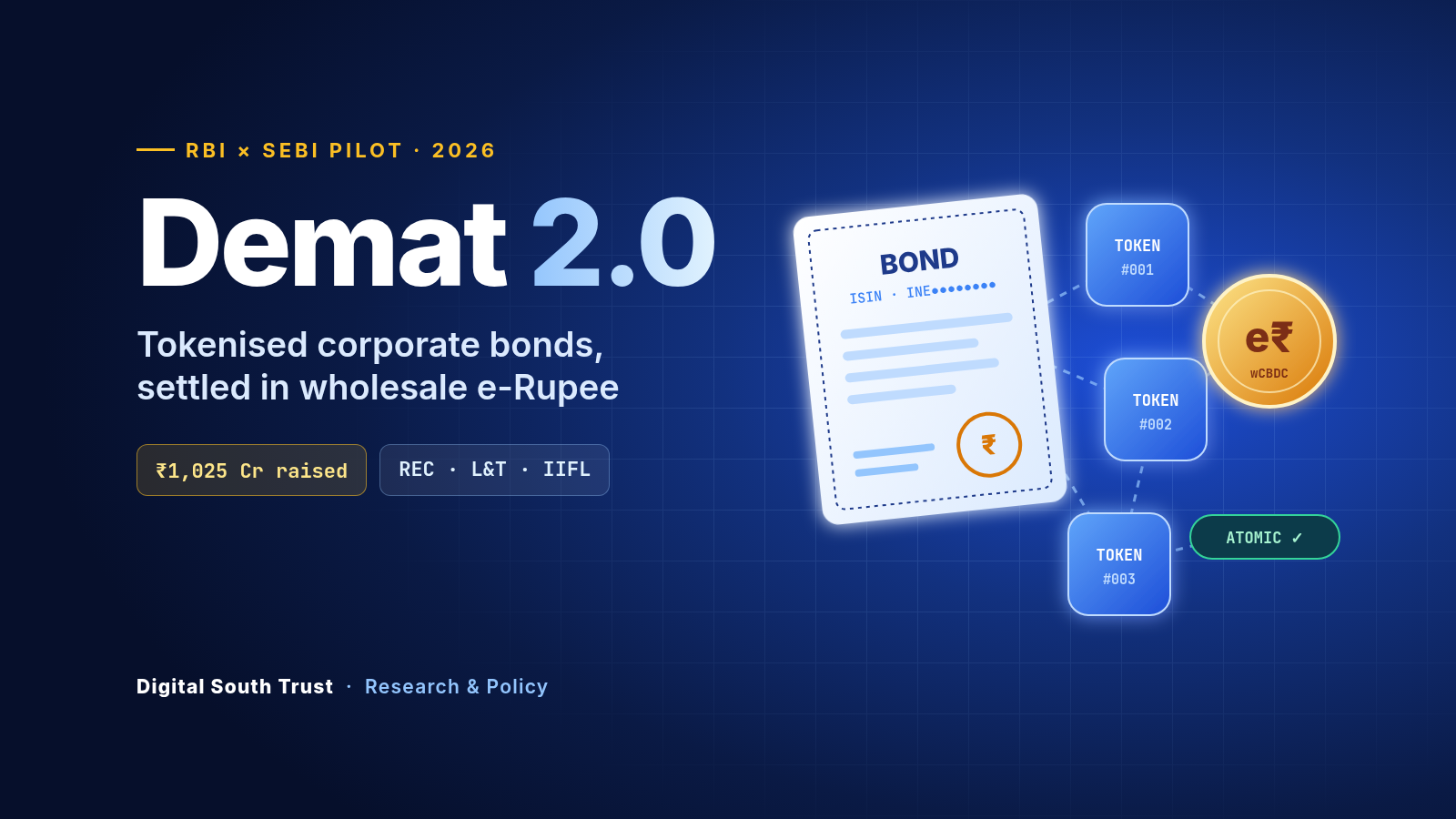
The pilot is called "Demat 2.0". Under it, corporate bonds are issued as digital tokens on a distributed ledger, and they settle against the RBI's wholesale Central Bank Digital Currency (e₹-W). In the days before the announcement, three companies had already raised a combined ₹1,025 crore through tokenised bonds.
This article explains what was launched, how it works, how it fits with RBI's wider tokenisation programme and the work in GIFT City, what a pending tokenisation bill in Parliament proposes, and the legal and policy questions that are still open.
1. What Was Announced
| Item | Detail |
|---|---|
| Announced | 10 September 2026, Global Fintech Fest, Mumbai |
| Announced by | RBI Governor Sanjay Malhotra and SEBI Chairman Tuhin Kanta Pandey |
| Name | Demat 2.0 (tokenised corporate bond pilot) |
| Instrument | Corporate bonds issued as digital tokens on a distributed ledger |
| Cash leg | RBI wholesale CBDC (e₹-W) through RBI's Unified Markets Interface (UMI) |
| Legal status | A pilot, not a binding regulation |
| Raised so far | ₹1,025 crore across three issuances |
The first three tokenised bond issuances
| Issuer | Date | Amount | Investors |
|---|---|---|---|
| REC Limited (public sector NBFC) | 7 September 2026 | ₹500 crore | 18 |
| Larsen & Toubro (L&T) | 9 September 2026 | ₹500 crore | 4 |
| IIFL (private NBFC) | 9 September 2026 | ₹25 crore | 1 |
| Total | ₹1,025 crore | 23 |
REC was the first issuer under the pilot. The small investor counts, one to eighteen per issue, show that this is a closely managed institutional test, not an open market yet.
2. How Demat 2.0 Works
Tokenisation often sounds like it means a new asset class. Demat 2.0 is deliberately the opposite: the bond stays exactly the same bond. Only the plumbing changes.
The bond does not change
- The tokenised bond keeps the same ISIN, coupon, maturity, covenants and credit rating as a conventional bond.
- Investor rights and the issuer's repayment obligations are unchanged.
- Credit rating, debenture trustee, listing and disclosure requirements continue to apply in full.
The infrastructure changes
- Private, permissioned ledger. The bonds are recorded on a distributed ledger that market infrastructure institutions maintain and the depositories own. It is not a public blockchain.
- The depository is still the record of ownership. Under the Depositories Act, 1996, the depository remains the legal record of beneficial ownership. The tokenised holding sits inside the investor's existing demat account.
- Atomic settlement. Through the UMI, the ledger connects to the RBI's wholesale CBDC. The bond and the payment move at the same moment, so neither side can deliver without the other. This is the delivery-versus-payment ideal that conventional settlement only approximates.
- Programmable payouts. Smart contracts can automate interest and redemption payments, which are credited as e₹ into bondholders' CBDC wallets on the due date.
- Faster capital for issuers. Issuers can receive funds on the same day as bidding, instead of the usual two to three days.
What an investor needs
- No new account and no fresh KYC. The token lives in the existing demat account.
- Demat 2.0 must be enabled with the investor's depository.
- The investor needs an e₹ wallet with a participating bank.
The roadmap
| Phase | Scope | Status |
|---|---|---|
| Phase 1 | Primary issuance of tokenised corporate bonds | Ongoing |
| Later phase | Secondary trading on existing Request-for-Quote (RFQ) platforms | Planned |
| Later phase | Retail investor access, guided by what the pilot shows | Planned |
| Longer term | Possible extension to equity, mutual fund units and Electronic Gold Receipts | Under consideration |
3. Demat 2.0 Is Part of a Larger RBI Programme
The bond pilot did not come out of nowhere. It is the most visible part of a tokenisation programme the RBI has been building for almost four years.
| Year | Development |
|---|---|
| November 2022 | The RBI launches its wholesale CBDC (e₹-W) pilot, starting with secondary-market settlement of government securities. |
| October 2025 | At Global Fintech Fest 2025, the RBI announces the Unified Markets Interface (UMI), a new market infrastructure for tokenising financial assets and settling them in wholesale CBDC. |
| October 2025 | The RBI begins a deposit tokenisation pilot with a small group of banks. |
| FY 2025–26 | A tokenised Certificate of Deposit (CD) pilot runs on the UMI, with settlement in e₹-W, according to the RBI's annual report. |
| September 2026 | Demat 2.0 applies the same infrastructure to SEBI-regulated corporate bonds. RBI officials have said they hope to add more asset classes to the UMI. |
The pattern is consistent. India is building tokenisation on regulated rails. It uses a sovereign settlement asset (the CBDC), regulated intermediaries (depositories and banks) and permissioned ledgers. It is not building on public blockchains or private stablecoins.
That is a deliberate policy choice. It matches the RBI's stated preference for the e-rupee over private stablecoins, which reflects the concerns about digital dollarisation and monetary sovereignty covered in our earlier research on USD-backed stablecoins.
4. The GIFT City Track: IFSCA and Real-World Assets
Onshore tokenisation is focused on bonds. India's International Financial Services Centre in GIFT City, regulated by the International Financial Services Centres Authority (IFSCA), has explored a wider range of real-world assets (RWAs).
- February 2025: consultation paper. The IFSCA published a consultation paper on the regulatory approach to tokenising real-world assets. It covers issuance and redemption, custody, trading, clearing and settlement, and centres on giving legal recognition to tokens that represent ownership or a beneficial interest in an underlying asset.
- There is still no final framework. The IFSCA has not issued a standalone tokenisation framework. A consultation paper does not grant regulatory permission.
- The current route is the sandbox. With no licensing category for tokenisation as a business, firms currently participate through a Limited Use Authorisation under the IFSCA FinTech Sandbox Framework.
- Market abuse rules apply. Market abuse regulations issued in September 2026 cover tokenised securities activity in the IFSC, including insider trading and manipulative practices.
GIFT City is best read as India's international test bed for tokenising real estate, infrastructure and other non-traditional assets. Demat 2.0 is the domestic, institution-first track for conventional securities.
5. The Asset Tokenisation (Regulation) Bill, 2026
The third part of the picture is in Parliament. On 14 March 2026, Rajya Sabha MP Raghav Chadha introduced the Asset Tokenisation (Regulation) Bill, 2026 as a Private Member's Bill. It is India's first dedicated legislative proposal on tokenising real-world assets.
Key features of the Bill
| Area | What the Bill proposes |
|---|---|
| Definition | An "asset token" is a cryptographically secured digital representation of a right, interest or economic benefit in an asset, recorded on distributed ledger technology. Issuing a token does not by itself transfer ownership of the underlying asset. |
| Scope | Traditional securities and also real estate, infrastructure, carbon credits and intellectual property |
| Regulator | No new regulator. Jurisdiction follows the underlying asset: SEBI for securities-linked tokens, RBI for payment, stable-value or banking-related tokens, and sectoral regulators (insurance, pensions) for others. Joint directions are permitted. |
| Lifecycle coverage | Origination, issuance, custody, trading, settlement and investor holding, with obligations on issuers, custodians and trading platforms |
| Investor protection | Registration, disclosure standards, prudential norms and grievance redressal for fraud, mis-selling and unfair trade practices |
| Penalties | Up to 10 years' imprisonment and fines up to ₹25 crore or three times the gains, whichever is higher, plus civil measures such as cease-and-desist orders, asset freezes and cancellation of registration |
| Transition | A migration path for existing projects and sandbox participants |
How likely is it to become law?
Realistically, the chances are low as drafted. The last Private Member's Bill passed by both Houses of Parliament was enacted in 1970, and as of September 2026 the Bill had not been enacted. Its value is in setting the agenda. It puts a coherent, technology-neutral legal design on record at a time when RBI and SEBI are already running live pilots. Any future government Bill is likely to borrow from it.
6. Why This Matters for India
For the corporate bond market
India's corporate bond market is still thin in the secondary market. Most bonds are bought and held to maturity by institutions. Tokenisation alone will not fix liquidity, but it removes some of the friction:
- Same-day funding lowers issuers' operational costs and timing risk.
- Atomic settlement removes counterparty settlement risk between the bond leg and the cash leg.
- Automated coupon and redemption payments cut reconciliation work and the risk of payment errors.
- A shared ledger gives authorised institutions a single, consistent view of who holds which bonds.
For the e-rupee
The wholesale CBDC finally has a concrete job. Retail e₹ circulation has struggled to grow. As a settlement asset for tokenised markets, however, e₹-W gives the RBI a strong reason for a sovereign digital currency, and a reason for markets to settle in central bank money rather than in private tokens.
For retail investors, eventually
Retail access is on the roadmap but is not available yet. If it arrives, it could make fractional and lower-ticket bond investing easier through the existing demat account, without crypto exchanges, offshore wallets or private stablecoins. That is a key difference from the unregulated "RWA tokens" now sold to Indian users on overseas platforms.
For India's place in global markets
Other financial centres are moving fast. Hong Kong issued its first tokenised green bond in 2023 and has since issued a record HK$10 billion digital green bond in four currencies, with some tranches settleable in central bank digital currencies. India's model is more cautious and more sovereign, but Demat 2.0 shows it is now taking part in this shift.
7. Open Questions and Risks
The pilot is promising, but several legal and operational questions are still open. Regulators and market participants will need to answer them before Demat 2.0 can scale.
- What is the regulatory basis? The public release does not say whether the pilot runs under a sandbox, an exemption or existing powers. A formal SEBI circular may follow.
- Which record is legal title? Within the pilot, the depository is the record of ownership. Outside it, whether the ledger entry or the depository record constitutes legal title still has to be settled, by contract for now and by law later.
- What if smart contracts and trust deeds conflict? If the code pays a coupon that the debenture trust deed would have withheld, or the reverse, the documents must say which governs and who bears the loss. How a debenture trustee's oversight works alongside automated payouts is still unclear.
- Who can participate? Issuer and investor eligibility criteria have not been published in detail.
- What about interoperability? There are no common Indian technical standards for DLT-based securities. Ledgers that cannot talk to each other would fragment liquidity, a problem we covered in our earlier article on blockchain interoperability.
- Is the system cyber- and quantum-resilient? Commentators note that SEBI is watching longer-term cryptographic risks, including quantum computing, for ledger-based market infrastructure.
- Is company law ready? The Companies Act, 2013 assumes a depository-based model for registers of members and share transfers. These provisions will become pressing if tokenisation extends to equity.
- How will AML and cross-border rules apply? As tokenised assets cross borders, particularly through GIFT City, beneficial ownership checks, transaction monitoring and FIU reporting must keep pace.
8. Digital South Trust Perspective
India's approach to tokenisation is regulated, sovereign and gradual, and that is the right foundation.
The important point about Demat 2.0 is not that India has "put bonds on a blockchain". It is that India has shown tokenised securities can work inside the existing legal framework of depositories, demat accounts, KYC, credit ratings and trustees, while settling in central bank money. That combination is what makes the model credible to institutions and safe to eventually open to retail investors.
Three priorities will decide whether the pilot becomes infrastructure:
- Legal certainty. A clear statutory position on tokens as securities, on the legal status of ledger records, and on how smart contracts relate to legal documents. Ideally this comes in a government Bill that builds on the 2026 Private Member's Bill.
- Common standards. Interoperable technical, custody and cybersecurity standards across depositories, exchanges, banks and GIFT City, so tokenised markets do not fragment.
- Investor education before retail access. Retail investors should understand tokenised products before they are offered to them. They should also be able to tell regulated tokenised bonds in their demat account apart from unregulated "tokenised asset" schemes sold through apps and social media. As with crypto, early clarity reduces fraud.
The RBI and SEBI have moved deliberately and in the right order: wholesale first, institutions first, and the regulated system first. If the next phases keep that discipline, tokenisation could give India's bond market the depth and efficiency it has lacked for decades.
References
- Angel One: SEBI, RBI Launch Demat 2.0 Pilot for Tokenised Corporate Bonds, CBDC Settlement (September 2026)
- CorpLawUpdates: SEBI-RBI Launch "Demat 2.0": Tokenised Corporate Bonds Pilot Explained
- The Tribune: RBI, SEBI launch India's first tokenised corporate bond pilot
- Trilegal: Tokenisation in India explained: What it means for securities regulation and investors (September 2026)
- IFSCA: Consultation Paper on Regulatory Approach towards Tokenization of Real World Assets (February 2025)
- Cyril Amarchand Mangaldas: India's First Asset Tokenisation Bill: What It Means for the Digital Assets Space (March 2026)
- Mondaq: India's Asset Tokenisation Bill 2026: A Landmark Proposal, a Fractured Legal Foundation and a Long Road to Passage
- Upstox: RBI Digital Currency FAQs: What is CBDC and Asset Tokenisation
- Morung Express / IANS: RBI expands e-rupee pilots, starts tokenised credit deposit trial
- The Standard (Hong Kong): Hong Kong issues record 10 billion digital green bonds in four currencies
This article is for research and public-awareness purposes only and does not constitute investment or legal advice. Demat 2.0 is a pilot, and its scope, eligibility and rules may change as RBI and SEBI issue further guidance.